Table of Contents
ToggleWhen Warner Bros. announced the live-action Minecraft movie, one question dominated every forum, subreddit, and Discord server: How would they handle Steve? The silent, blocky avatar who’s been punching trees and dodging Creepers since 2011 is arguably gaming’s most recognizable blank slate. Now, with the film finally hitting theaters in 2025 and still sparking conversations in 2026, we’ve got answers, and they’re weirder, more ambitious, and more faithful to the source material than anyone expected.
This isn’t just another video game adaptation trying to distance itself from its roots. The Minecraft movie leans into the game’s DNA while giving Steve an actual personality, backstory, and emotional arc. Whether you’ve spent thousands of hours in-game or you’re just curious how Hollywood tackled one of gaming’s strangest icons, here’s the complete breakdown of Steve’s movie incarnation.
Key Takeaways
- Jack Black plays Steve as an eccentric, thousands-of-hours veteran survivor rather than the silent game protagonist, serving as mentor and guide to human newcomers who become the film’s main characters.
- The Minecraft movie successfully adapts Steve from a blank-slate avatar into a fully realized character with personality, backstory, and emotional depth while preserving his core identity as a builder, crafter, and strategist.
- Steve’s visual design combines blocky proportions with realistic textures and materials, creating a hybrid appearance that grounds him in the Minecraft world and makes him recognizably iconic despite his unconventional look.
- The film treats Minecraft mechanics like crafting, building, and combat as actual gameplay systems translated to action sequences, rewarding player knowledge and making Steve’s expertise feel genuinely powerful and earned.
- The Minecraft movie sparked renewed community engagement, spawning challenge videos, meme culture, and increasing player interest, while validating live-action adaptations of stylized games and opening doors for expanded universe content.
Who Is Steve in Minecraft?
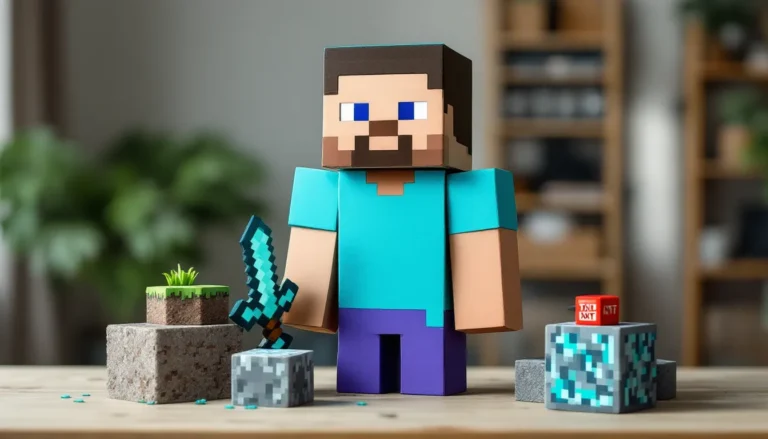
Before diving into the film, let’s establish the baseline. Steve is Minecraft’s default player character, introduced when the game was still in its alpha stages back in 2009. He’s the blue-shirted, bearded avatar with no voice, no backstory, and no defined motivation beyond survival and creativity.
In-game, Steve is whatever you want him to be. A builder. A fighter. An explorer. A redstone engineer. That intentional blankness is what made Minecraft work, players project themselves onto Steve rather than following a scripted narrative. He’s gaming’s ultimate everyman, existing solely as a vessel for player agency.
Over the years, Steve became a cultural icon beyond the game itself. He appeared in Super Smash Bros. Ultimate as a playable fighter in 2020, complete with his crafting and building mechanics translated into a fighting game moveset. Merchandise, memes, and millions of player skins cemented his status as one of gaming’s most recognizable figures, even if most people couldn’t tell you a single thing about his “personality.”
The movie had to solve an impossible problem: give Steve character without erasing what makes him Steve. That tightrope walk is what defines his entire film presence.
Steve’s Role in the Minecraft Movie
Who Plays Steve in the Movie?
Jack Black plays Steve in the Minecraft movie, a casting choice that raised eyebrows when first announced but eventually became one of the film’s strongest elements. Black doesn’t play Steve as the silent protagonist from the game, instead, he’s a seasoned Minecraft veteran who’s been surviving in the blocky world for years, possibly decades.
Black’s Steve is eccentric, slightly unhinged from isolation, and deeply knowledgeable about the game’s mechanics in a way that borders on obsessive. Think of him as the in-universe equivalent of a player with 5,000+ hours logged, someone who knows every crafting recipe by heart and has strong opinions about the optimal mining level for diamonds (Y-level -59 in the current 1.20+ versions, for the record).
The film’s protagonist is actually a group of regular humans who get pulled into the Minecraft world. Steve serves as their guide, mentor, and occasional comic relief, a role that lets the movie explain game mechanics naturally while keeping Steve in his element.
How the Film Adapts Steve’s Character
The adaptation makes Steve a worldbuilding device rather than the main character. He’s already mastered survival, already built his fortress, and already understands the rules of this universe. The newcomers are the audience surrogate, but Steve represents what you become after hundreds of hours in-game: confident, resourceful, and maybe a little too comfortable living alone in a cube house.
Critically, the film preserves Steve’s core identity as a survivor and creator. His base showcases ridiculous builds, automated farms, elaborate redstone contraptions, and aesthetic touches that any veteran player would recognize as the mark of someone who’s moved past “survival mode” into “I’m going to build a working calculator for fun” territory.
The movie also addresses the elephant in the room: Steve’s silence in the game. Rather than making him mute, the film suggests he simply chose not to talk much after years of isolation. When he does speak, it’s purposeful, knowledgeable, and often delivered with the energy of someone who’s forgotten how normal conversations work. Black’s performance threading that needle between comedy and genuine survival expertise makes it work.
Steve’s Appearance and Design in the Film
From Blocky Avatar to Live-Action Hero
Here’s where things get divisive. The filmmakers faced an impossible choice: make Steve fully realistic and lose the iconic design, or keep him blocky and risk uncanny valley nightmare fuel. They chose a middle ground that gaming communities still debate.
Steve retains his cubic head and blocky proportions, but with texture, depth, and realistic materials applied. His skin has pores. His beard has individual hairs (though they grow in a distinctly rectangular pattern). His blue shirt looks like actual fabric, not a flat texture slapped onto a model. The result looks like someone built a real person using Minecraft blocks as the blueprint.
Early reactions across gaming coverage platforms were mixed. Some players loved the commitment to the source material. Others found the realistic-blocky hybrid unsettling. By the film’s release, most audiences accepted it as the only viable approach, going full realism would’ve made Steve unrecognizable, but going full blocky would’ve been impossible to take seriously in emotional scenes.
The film also includes a visual gag where Steve’s proportions are compared to the “normal” humans in the Minecraft world, highlighting just how weird his cubic build actually is when placed next to regular anatomy.
Costume and Visual Effects Breakdown
Black wore a practical costume with a prosthetic cubic head for most scenes, with CGI enhancements added in post-production. This hybrid approach gave him actual physical presence and weight while allowing for impossible angles and movements during action sequences.
The blue shirt and purple pants are game-accurate, though given realistic wear and tear, patches, dirt stains, and fading that suggest years of use. Steve’s inventory is visualized through a holographic grid that appears when he accesses items, a clever solution that keeps the game’s UI logic without breaking visual immersion.
Lighting and texture work make Steve look like he belongs in the Minecraft world rather than the real world, which is crucial since the film’s premise involves regular humans entering the game’s dimension. Steve’s blocky aesthetic matches the environment: the humans stand out as the weird ones.
Steve’s Personality and Character Development
Game Steve has no personality. Movie Steve has arguably too much, and that’s exactly what the film needed.
Black’s portrayal leans into survivalist competence mixed with social awkwardness. Steve knows how to handle a Creeper ambush or set up a mob farm, but he’s forgotten how to interact with other people. He speaks in game terms, referring to real-world concepts using Minecraft vocabulary, calling nighttime “mob spawn hours,” and treating death as an inconvenience that costs you your items rather than an actual threat.
The character arc involves Steve reconnecting with humanity (literally) through his interactions with the newcomers. He starts as a hermit who’s optimized his survival routine into a lonely perfection, then gradually remembers why building and exploring are more meaningful when shared with others. It’s a surprisingly emotional thread that mirrors the game’s evolution from solitary survival to community-driven creativity.
Steve’s humor comes from his matter-of-fact delivery of absurd game logic. He treats eating a whole cake to heal wounds as perfectly normal. He’s confused why the humans won’t just respawn at their beds. He’s genuinely baffled that they don’t understand redstone timing. This fish-out-of-water dynamic (except he’s the fish who’s perfectly comfortable, and everyone else is out of water) provides consistent comedy without making Steve a joke.
Critically, the film avoids making Steve incompetent or cowardly, a common trap in video game adaptations. He’s the most capable person in any dangerous situation, a veteran who’s survived everything the Minecraft world can throw at him. That competence is never undercut for cheap laughs.
Steve’s Abilities and Skills in the Movie
Crafting and Building
The film treats crafting as Steve’s signature ability, visualized through a holographic 3×3 grid that appears when he accesses his inventory. Materials slot into the grid in real-time, then compile into the finished item with a satisfying pop and particle effect. It’s game-accurate enough to please players while being visually clear for non-gamers.
Steve crafts constantly throughout the film, tools, weapons, shelter, and increasingly complex items as situations demand. The movie uses crafting as action beats: Steve rapidly assembling a pickaxe mid-chase, building a bridge across a lava lake under time pressure, or constructing a defensive wall while mobs close in. These sequences feel like actual gameplay translated to film, complete with the tension of having limited resources.
Building showcases Steve’s mastery in quieter moments. He constructs elaborate structures with speed and precision that suggest thousands of hours of practice. One sequence shows him building a multi-story defensive tower in real-time during a siege, placing blocks with the efficiency of a speedrunner. It’s the film’s way of showing Steve’s expertise without dialogue, his building patterns alone communicate veteran-level skill.
Combat and Survival
Steve fights exactly like a skilled Minecraft player. He crit-hits by jumping, times his sword swings to maximize damage, and uses shields to block Creeper explosions at the last possible second. The combat choreography incorporates game mechanics as deliberate techniques rather than trying to make fights “realistic.”
His approach to survival is textbook optimal Minecraft strategy. He avoids unnecessary risks, always secures his spawn point, never mines straight down, and treats resource management as second nature. When teaching the newcomers, he emphasizes the same lessons the game teaches: light up areas to prevent spawns, always carry food, and never waste diamonds on hoes (a joke that landed perfectly with gaming audiences when discussions emerged across gaming culture outlets).
The film also showcases environmental mastery, Steve using lava buckets, water source blocks, and terrain manipulation to control fights. He doesn’t just swing a sword: he engineers victory through preparation and clever use of game mechanics. It’s combat design that rewards Minecraft knowledge and makes Steve feel genuinely powerful without resorting to impossible action hero physics.
Steve’s Relationships with Other Characters
Steve’s isolation means his relationships are the film’s emotional core. He initially treats the human newcomers as temporary NPCs, useful for trading, maybe, but not worth emotional investment. That wall breaks down gradually as they prove they’re willing to learn, adapt, and contribute to the group’s survival.
The primary dynamic is Steve as reluctant mentor. He’s not naturally patient, but he recognizes that letting the newcomers bumble around will get them (and him) killed. His teaching style mirrors how experienced players teach new ones: blunt, practical, and occasionally exasperated, but eventually effective.
One standout relationship is between Steve and a young player-character who reminds him why he loved Minecraft before it became just a survival routine. Their building competitions, collaborative projects, and shared sense of wonder at discovering new biomes reignite Steve’s passion for exploration. It’s a relationship that mirrors how multiplayer transforms Minecraft from a game about survival to a game about shared creativity.
The film also teases a history with other players who entered the Minecraft world before, some who succeeded in returning home and others who… didn’t. These ghosts haunt Steve’s reluctance to get attached, adding stakes to the newcomers’ journey and depth to Steve’s protective instincts.
No forced romance, no contrived conflicts, just relationships built on mutual survival, teaching, and learning. It’s refreshingly grounded for a fantasy adventure film.
How Steve Compares to the Game Version
Game Steve is a silent shell. Movie Steve is a fully realized character. That gap is either a betrayal or a necessity depending on who you ask, but the filmmakers clearly understood the assignment: preserve the core while adding what film demands.
What stayed the same:
- Appearance (blocky, blue shirt, bearded)
- Core competencies (mining, crafting, building, fighting)
- Playstyle approach (methodical, resource-conscious, strategic)
- Role as the ultimate survivor in a hostile world
What changed:
- Voice and dialogue (necessary for film narrative)
- Defined personality (eccentric, knowledgeable, socially awkward)
- Backstory and history (years of isolation, possible previous encounters)
- Emotional arc (rediscovering purpose through connection)
The smartest adaptation choice? Making Steve an experienced player-equivalent rather than a beginner. The film doesn’t waste time on basic tutorials because Steve already mastered them. He’s post-Ender Dragon, post-Wither, deep into the endgame grind. That positions him as aspirational, the player you’ll become after enough hours, rather than an entry-level avatar.
Fans debated whether Steve should’ve remained silent, but film structure makes that nearly impossible for a major character. The compromise, making his speech patterns reflect game logic and veteran player knowledge, was probably the best available option.
One significant departure: movie Steve can’t actually die and respawn. The film treats death as permanent, raising stakes considerably and removing one of the game’s core safety nets. This makes Steve’s survival expertise more impressive and his caution more justified.
Fan Reactions and Community Response
The Minecraft community’s response to Steve’s portrayal was cautiously positive, a minor miracle for a video game movie adaptation. Initial trailer reactions skewed negative, mostly due to the uncanny visual design, but opinions warmed considerably after release.
What players loved:
- Accurate game mechanics translated to screen
- Jack Black’s commitment to the bit without making Steve a joke
- References and Easter eggs that rewarded long-time players
- Treating Minecraft knowledge as actual expertise rather than childish trivia
- Steve’s competence and veteran-level skill rather than bumbling incompetence
What divided fans:
- The blocky-but-textured visual design (some loved it, others wanted full stylization)
- Giving Steve a voice and defined personality
- The level of comedy versus serious adventure tone
- Certain creative liberties with game lore and mechanics
Content creators had a field day. YouTube and Twitch exploded with “Minecraft Movie Steve in-game challenge” videos, recreating his builds, testing his strategies, and analyzing whether his tactics would actually work. Speedrunners debated his efficiency. Builders critiqued his base design. The film sparked renewed interest in Minecraft itself, with player counts spiking after release.
Comparisons between Steve’s movie portrayal and other gaming and entertainment coverage highlighted how rare it is for adaptations to respect source material this thoroughly. The film wasn’t perfect, but it understood Minecraft in ways most video game movies don’t understand their source games.
Meme culture embraced movie Steve immediately. His deadpan delivery of absurd game logic, his rectangular beard, and his casual competence in impossible situations became instant reaction image material. The “Steve explains basic Minecraft concepts to confused humans” format dominated gaming meme subreddits for months.
Some purists argued the film should’ve been fully animated in Minecraft’s visual style, pointing to the success of Minecraft: Story Mode’s art direction. Others countered that live-action was necessary to reach broader audiences and justify the theatrical release. That debate continues, though box office numbers suggested the live-action approach worked commercially.
What Steve’s Movie Appearance Means for Minecraft’s Future
Steve’s successful film adaptation opens doors Microsoft and Mojang have been eyeing for years. The character proved he can carry mainstream entertainment outside the game itself, which has immediate implications for Minecraft’s transmedia expansion.
The most obvious impact: Steve is now a defined character in popular culture, not just a blank avatar. That creates opportunities for sequels, spin-offs, and expanded universe content that can reference movie-Steve as a consistent character rather than a malleable player stand-in. Whether that’s good for Minecraft’s “you are Steve” philosophy is debatable, but it’s undeniably profitable.
Microsoft announced merchandise partnerships within weeks of the film’s release, action figures, clothing lines, and even a special “Movie Steve” skin pack in-game that recreated Jack Black’s portrayal. The skin pack became one of the best-selling Marketplace items in Minecraft history, proving players were willing to adopt this specific version of Steve as canon.
The film’s success also validated live-action adaptations of stylized games, potentially influencing how other gaming properties approach film deals. If Minecraft can work in live-action while preserving its visual identity, other “impossible” adaptations become more feasible.
Longer-term, expect Steve to become Minecraft’s mascot in more explicit ways. He’s always been the de facto face of the game, but now there’s a personality and characterization to build from. Theme park attractions, animated series, and expanded game modes featuring “story Steve” rather than blank-slate Steve are all on the table.
The film also introduced non-players to Minecraft through a narrative entry point. Steve-as-mentor creates a natural tutorial structure that could be adapted into game content, imagine a new game mode where veteran-Steve teaches players advanced techniques, narrated by Black. That’s the kind of crossover opportunity Hollywood success enables.
Whether this expanded universe approach enhances or dilutes Minecraft’s core appeal is the question Mojang will grapple with going forward. For now, Steve successfully made the jump from game to film without losing what made him iconic, and that’s a win worth building on.
Conclusion
Steve’s journey from silent pixel avatar to Jack Black’s eccentric survival expert is one of the stranger success stories in video game adaptations. The film threaded an impossible needle, giving personality to a character defined by having none, making him visually recognizable while adapting to live-action, and keeping him competent without making him boring.
The result is a Steve who feels like the logical conclusion of thousands of gameplay hours: skilled, knowledgeable, slightly obsessive, and eager to share what makes Minecraft special once he remembers why it mattered in the first place. Whether you’re a veteran player who’s been punching trees since alpha or someone who’s never crafted a pickaxe, movie Steve works as both guide and character.
He’s not the Steve you played as, but he’s recognizably the Steve you became after enough time in that blocky world. And honestly? That’s probably the best version of Steve a movie could’ve given us.